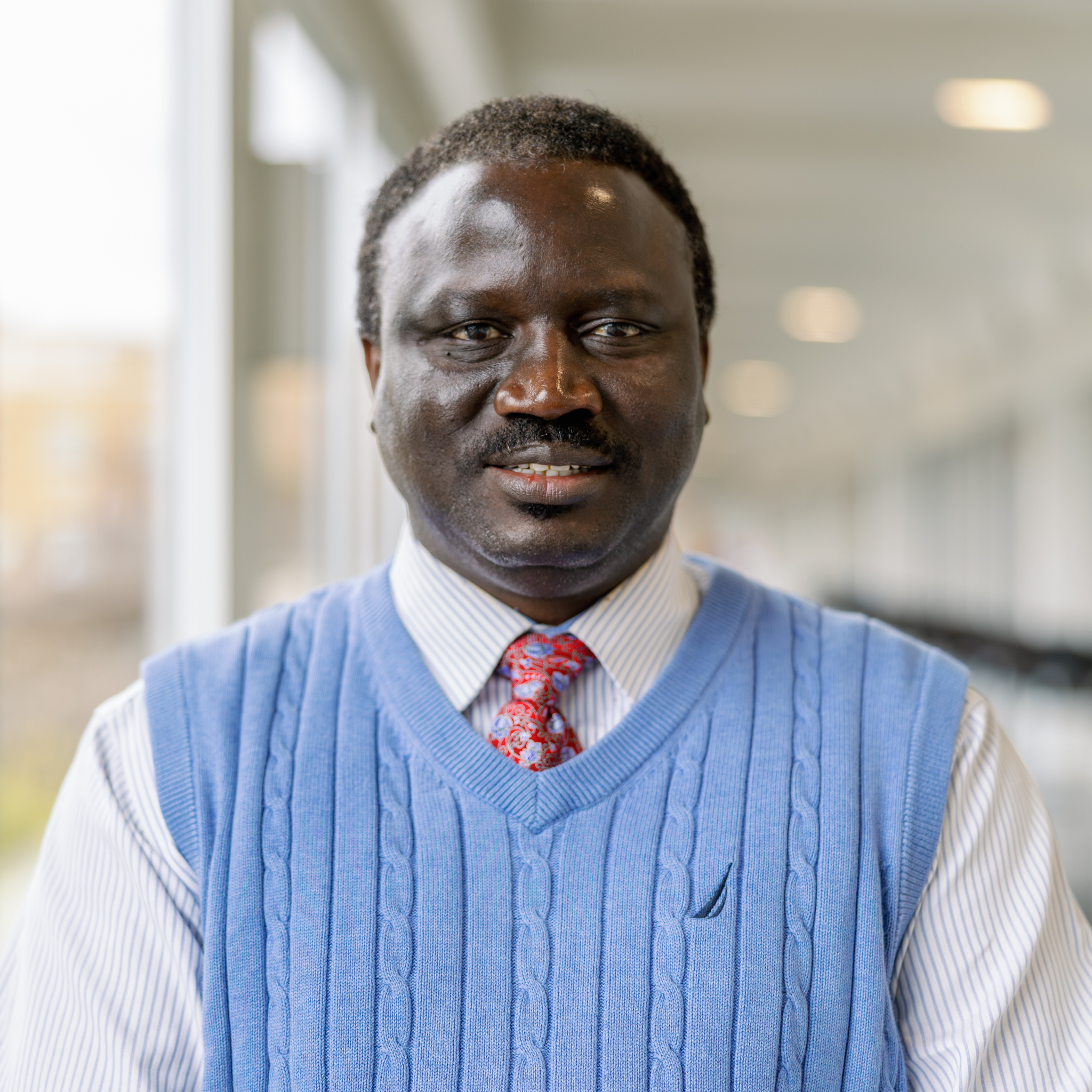


We’re excited to welcome Demba Sarr, PhD, to the College of Pharmacy! Dr. Sarr joins us as a Lecturer in Pharmaceutical and Biomedical Sciences.
Dr. Demba Sarr, Lecturer in Pharmaceutical and Biomedical Sciences
- Where are you from originally? What brought you to Athens and UGA?
- I am originally from Senegal in Western Sub-Saharan Africa. While pursuing myPhD at Cheikh Anta Diop University in Dakar, I traveled to many African countries to participate in international workshops designed for African Young Scientists. These programs were led by international faculty, including researchers from U.S. institutions. I also attended scientific meetings in France and the United States. Through these experiences, I built strong networks with peers and faculty—including Professor Julie M. Moore, then in the Department of Infectious Diseases and the Center for Tropical and Emerging Global Diseases at the University of Georgia College of Veterinary Medicine in Athens. She is now at the University of Florida College of Veterinary Medicine.
- After completing my PhD in 2005, I had the opportunity to come to the United States as a permanent resident. I contacted Prof. Moore from Dakar and later from Brooklyn, NY. She encouraged me to come to Athens, generously covering my travel and accommodation expenses. During my first visit, I toured her lab, attended lab meetings, and presented my research to faculty in the College of Veterinary Medicine and the Center for Tropical and Emerging Global Diseases.
- Shortly after I returned to Brooklyn, Prof. Moore called to offer me a postdoctoral research scientist position in her laboratory at UGA. Within a few days, I moved from Brooklyn to Athens by Amtrak, arriving on the morning of March 19, 2007. From that day forward, I became a resident of Athens.
- I worked in Prof. Moore’s lab from March 2007 to March 2017, first as a postdoctoral research scientist associate and later as an assistant research scientist. I then joined the Department of Infectious Diseases, where I worked with Professor Balazs Rada from May 2017 to June 2025. I have now been living in Athens for the past 18 years.
- Where did you receive your training/education?
- I attended Cheikh Anta Diop University in Dakar, Senegal, where I earned myPhD in Biology in 2005. My doctoral studies were conducted at the Institut Pasteur of Dakar in the Department of Clinical Immunology, where I worked on the immunopathogenesis of malaria during pregnancy. My earlier biomedical research training took place at the French Institute for Research and Development also in Dakar, where I studied schistosomiasis in the Senegalese River Bassin, and at the Institut Pasteur of Dakar, where I focused on malaria4. immunological research in pregnant women living in urban and peri-urban areas of Dakar. My PhD advisors were Dr. Ronan Jambou, a French physician-scientist from the Pasteur Institute Network, and Prof. Omar Thiom Thiaw, a Senegalese biologist affiliated to Cheikh Anta Diop University, Faculty of Sciences.
- I later had the opportunity to come to the United States, where I received extensive additional training as a postdoctoral research scientist at the Center for Tropical and Emerging Global Diseases and the Department of Infectious Diseases at the University of Georgia in Athens, GA.
- How did you become interested in your chosen field/profession? What are your areas of interest and expertise?
- I grew up in Senegal, a country in Western Sub-Saharan Africa where malaria is endemic. Malaria is a parasitic disease caused by protozoan parasites that are transmitted to humans through female anopheles mosquito bites, and its cyclical symptoms—fever, chills, headache, muscle aches, nausea, and vomiting—can become life-threatening if not treated promptly. In the 1970s, when I was born, preventive therapies were rare, and research on malaria was far less advanced than it is today. As a boy growing up in rural Senegal, I could easily have died from malaria, especially since many villages, including my home village of Ndianda, lacked accessible healthcare facilities within even an hour’s reach. I experienced multiple malaria infections throughout my childhood, including severe and cerebral malaria, as well as urinary schistosomiasis—yet I survived these illnesses. A Catholic sister (nun) from the nearby village of Ngazobile played an important role in community health: she regularly drove to our village to weigh babies and provided medical care to children and mothers (clinical diagnostic, medication, and vaccines) and helped with potential medical transportation to healthcare facilities surrounding the area. These early experiences shaped my determination to pursue infectious diseases research. During my undergraduate studies in Senegal, I committed myself to understanding diseases that had affected my community. I first conducted research on intestinal schistosomiasis in northern Senegal for my master’s degree, followed by doctoral work focused on the immunopathogenesis of malaria during pregnancy.
- What previous, relatable job experiences do you bring to your new position at CoP? Did you work at other locations on campus?
- Previously, I worked in the Department of Infectious Diseases at the University of Georgia for the past 18 years. I co-taught special topics in immunology and advanced immunology courses to graduate students in the College of Veterinary Medicine. I also helped with bacterial pathogenesis journal clubs as well as Special topics in Diseases intervention. While I have never been a Course coordinator in the past, I have worked with several faculty members in the department of infectious diseases for their teaching and research duties.
- Why were you interested in applying for this position and coming to CoP/UGA?
- I love teaching—developing syllabi and lectures and working with students to find the most effective ways to present material so that it is clear, engaging, and accessible. At this point in my career, investing my efforts in teaching is an important step toward advancing in academia. I decided to apply for this position because it aligns not only with my professional goals but also with my desire to contribute meaningfully to the teaching, research and service missions of the Department of Pharmaceutical and Biomedical Sciences, the College of Pharmacy, and the University of Georgia.
- Immunology is a scientific discipline that continues to expand our understanding of how to prevent and treat major health challenges through ongoing research in immunotherapy, autoimmune diseases, and vaccines for emerging and re-emerging pathogens such as COVID-19 and Ebola. Just as Edward Jenner’s foundational work in the 18th century paved the way for major scientific breakthroughs in the 19th and 20th centuries, educating future generations in immunological concepts is essential for continued progress. This is one of the key reasons I applied for this role. I want to be among the professors who successfully prepare the next generation to advance our understanding of basic immunology for clinical care, biomedical research, and biotechnological innovation.
- Despite significant advances in disease prevention, diagnostics, and treatment, we still need new tools—and we need to integrate modern technologies, including artificial intelligence, to accelerate and improve the management of a wide range of diseases. Teaching the next generation of scientists and healthcare professionals is central to achieving that goal.
- What will you be responsible for in your new position?
- In my new position, I will be responsible for coordinating Introduction to Human Immunology (PMCY 4110), a new course for undergraduate students in Pharmaceutical and Biomedical Sciences in the College of Pharmacy. My responsibilities include preparing and updating the syllabus, developing and revising classroom lectures, creating and updating midterm exams and unit tests, grading student assignments, and submitting final grades to Athena. I will also manage course communication with students and create and maintain the Teams Classroom for PMCY 4110, as well as for other courses such as PMCY2020 when needed.
- I am committed to contributing honestly, respectfully, and accurately to the mission of the College of Pharmacy and the University of Georgia. My goal is to support and elevate students’ confidence, knowledge, and long-term success—both now and throughout their future professional careers.
- Personal information you would like to share:
- Town in which you currently reside: Athens, GA
- Outside interests/hobbies: Soccer and American Football
- Family, including animals and pets: I am married and have 5 children
- Memberships in clubs, organizations, etc: American Association of Immunologists, Founder of the International association for the development of Ndianda, Co-founder of Teranga Biomedical Research and Innovative Training
- Contact info at the College
- Email: [email protected]
- Office Room number: PBS 334
- Office Team Phone Number : 706 542 7410
- Anything else you would like to share with your new PharmDawg colleagues?
- Hopefully, I will have the opportunity to meet more colleagues and discuss myskills and experiences with them to explore potential research and teaching collaborations.